
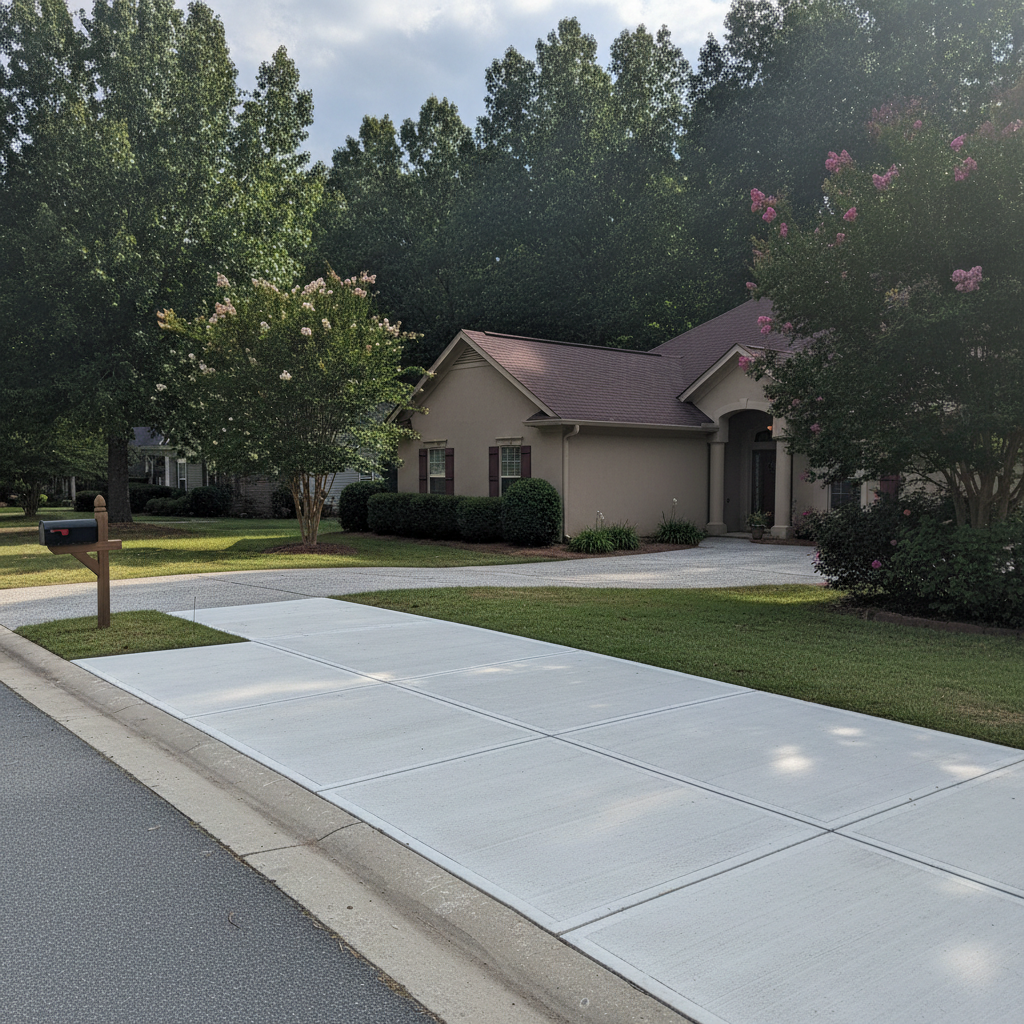
Anybody with a trailer and a few bags of Quikrete can call themselves a concrete contractor. Durham has a lot of them right now, because the Triangle has been building nonstop for a decade and every crew in three counties knows it. Some of them do fine work. Some of them will pour your driveway on a Tuesday and be impossible to reach by the following spring when it cracks. The hard part is telling the difference before you've signed anything.
This isn't about finding the cheapest bid. It's about understanding what the job actually involves, so you can tell when someone's cutting a corner you'd never notice until it's under four inches of concrete.
Start with the ground, because Durham's soil decides a lot of this
Most of Durham sits on Piedmont clay. It holds water, it swells when it's wet, and it shrinks and cracks when it's dry. A patio or driveway poured on clay that wasn't compacted properly will move with the seasons, and that movement shows up as cracking, heaving, or a slab that's noticeably out of level within a year or two. A contractor who knows the area will talk to you about sub-base before they talk to you about finish. That usually means excavating down 4 to 6 inches below the slab, laying crushed stone, and compacting it in lifts rather than dumping it all in at once and running a plate compactor over the top once.
Ask what they're doing for the sub-base. If the answer is vague, or if someone tells you clay is fine to pour directly on, that's a reason to keep looking. Neighborhoods like Trinity Park, Duke Park, and Old West Durham have houses from the 1920s through the 1950s, and a lot of that older ground has been disturbed by past additions, old sidewalks, and tree roots that have since died off and left voids underneath. Newer subdivisions out toward Brier Creek or north Durham are often built on cut-and-fill lots, where part of your yard sits on native clay and part sits on fill brought in during grading. A contractor who's worked both knows they behave differently and will test or at least ask about it.
Rebar, wire mesh, and the mix itself
For a driveway or a slab foundation, you want to know whether they're using rebar or wire mesh, and how thick the slab is going to be. A standard residential driveway in this area is usually 4 inches thick with either a fiber-reinforced mix or welded wire mesh, sometimes rebar on 18 to 24 inch centers for anything carrying heavier loads, like an RV pad or a slab that'll have a detached garage on it. Four thousand PSI concrete is a reasonable standard to ask for around here, given our freeze-thaw swings. Durham doesn't get brutal winters, but we do get roughly 20 to 30 nights a year that dip below freezing after a wet day, and that cycle of water getting into hairline cracks and expanding is what turns a small crack into a chunk missing from your step.
Ask what PSI mix they're quoting and whether they adjust it for a driveway versus a patio versus a foundation. If every answer is the same regardless of the job, that's a sign they're not actually thinking about it.
Control joints, curing time, and the heat
Concrete cracks. That's not a defect, that's physics, and every slab will find a place to crack eventually. The job of control joints is to tell it where to crack instead of leaving it to chance. A competent crew saw-cuts those joints within 24 hours of the pour, spaced roughly every 8 to 10 feet for a driveway. If a contractor doesn't mention control joints at all, or plans to skip them to save time, walk away.
Durham summers matter here too. July and August regularly hit the mid-90s with heavy humidity, and concrete poured in that heat cures faster on the surface than underneath, which can cause surface cracking if nobody's misting it or using a curing compound. A contractor who's done this for a while will talk about pour timing, early morning pours in summer, and won't pour at all during a thunderstorm, which the Triangle gets plenty of between May and August. You'll typically wait 24 to 48 hours before walking on fresh concrete and about 7 days before driving a car on it, longer if it's a thicker slab or the weather's been cold.
Permits, setbacks, and HOAs
Depending on where you are, permitting runs through the City of Durham or Durham County, and a driveway, patio, or any structural slab work usually needs one, along with an inspection of the footing or sub-base before the pour and sometimes a final inspection after. A legitimate contractor pulls the permit themselves or walks you through doing it, and they'll know whether your lot needs a setback check, especially if you're adding a slab near a property line or an easement. If someone tells you permits aren't necessary for a driveway replacement, double check that yourself before you believe it. Rules vary by project type and by whether you're inside city limits or out in the county.
If you're in a newer subdivision with an HOA, which is common throughout the Triangle, check your covenants before you pick a color or finish for stamped concrete or a patio. Some HOAs restrict colors, patterns, or even require architectural review before pouring anything visible from the street.
What a real quote looks like
A written estimate should spell out slab thickness, PSI, reinforcement type, sub-base prep, and a rough timeline including cure time before you can use the space. It should list who pulls the permit. Verbal quotes with no paper trail, requests for full payment up front, and a price that's dramatically lower than two other bids are the three things that should make you pause. A fair deposit is normal. Paying the whole job before a shovel touches the ground is not.
Ask for a few addresses of past work you can drive by yourself, not just photos. A slab that's held up through five Durham winters tells you more than any sales pitch. If you want to see how we handle sub-base prep, reinforcement, and permitting on jobs around Durham, our concrete contractor work is a decent place to start comparing against whatever bids you're already holding.